Toronto Police Chief Bill Blair speaking to officers in the processional at Const. John Zivcic’s funeral. Photo by Kateryna Barnes
It was cold today, but thousands of officers still lined up in a processional and many marched to the Toronto Congress Centre for the funeral of Const. John Zivcic.
Zivcic was killed after his cruiser struck another car. He was 34 years old.
The funeral brought out all the dignitaries, including Chief Bill Blair, Premier Kathleen Wynne and Mayor Rob Ford.
Lynda Webb, a retired nurse came from Pickering, Ont. for the funeral, despite not knowing Zivcic or his family.
“My heart breaks for this young man; I just want to say thank you to all of the men and women in uniform.”
A couple of the officers from 14 Division I sat next to said it’s a hard part of their job to attend police funerals.
I called into @Humber, after running to my car (quieter) and nearly giving myself an asthma attack for this story.
On December sixth 1989, a lone gunman targeted and killed fourteen women at Montreal’s École Polytechnique, shocking the nation.
According to a Statistics Canada Survey, 51% of Canadian women over the age of 16 have experienced gender-based violence.
Many groups want to change that reality. One such group is The White Ribbon Campaign, an organization focused on motivating men and boys to end gender-based violence.
Jeff Perera is the community engagement manager with the White Ribbon Campaign and I spoke with him about the campaign.
For more information on the campaign, you can visit whiteribbon.ca
Fourteen victims of École Polytechnique
Geneviève Bergeron (born 1968), civil engineering student
Hélène Colgan (born 1966), mechanical engineering student
Nathalie Croteau (born 1966), mechanical engineering student
Barbara Daigneault (born 1967), mechanical engineering student
Anne-Marie Edward (born 1968), chemical engineering student
Maud Haviernick (born 1960), materials engineering student
Maryse Laganière (born 1964), budget clerk in the École Polytechnique’s finance department
Maryse Leclair (born 1966), materials engineering student
Anne-Marie Lemay (born 1967), mechanical engineering student
Sonia Pelletier (born 1961), mechanical engineering student
Michèle Richard (born 1968), materials engineering student
Annie St-Arneault (born 1966), mechanical engineering student
Annie Turcotte (born 1969), materials engineering student
Barbara Klucznik-Widajewicz (born 1958), nursing student
For my final story in Advanced Online, I was very lucky– I got to host Humber News Express. HNE is a more casual and quick dose of the top headlines of the day. I was responsible for choosing the stories, writing them, lining them up, hosting, and cutting the video. I did have help from my friend, Justin Vasko, who was a fantastic videographer and human teleprompter.
Pro tip: make sure your human teleprompter holds your sheets of paper *just below* the camera lens. Or make sure you have a real teleprompter. Either way, I’m still pretty happy with how it turned out, -17 C and all.
For two minutes of Friday’s top headlines, check it out:
“The main issue we’re concerned about whether or not Canadians were caught up in this surveillance,” said Sukanya Pillay, the executive director of the Canadian Civil Liberties Association.
“We’re also concerned about allowing a foreign agency to come on our soil and potentially surveil Canadians.”
The briefing notes don’t detail the targets of the surveillance, but they state that the American embassy in Ottawa was turned into a security command post during a six-day surveillance operation by the NSA during the summit in Toronto.
There were two groups that the surveillance targeted: foreign diplomats and “extremist groups”.
“During the G20 many peaceful protesters and many non-protesters were swept up in the mass arrests,” said Pillay.
“Given that this is what was going on the ground, we’re concerned with what was going on in terms of surveillance.”
When asked by Humber News about the surveillance, the NSA declined to respond to the question.
“While we are not going to comment publicly on every specific alleged intelligence activity, as a matter of policy the U.S. government has made clear that the United States gathers foreign intelligence of the type gathered by all nations,” Vanee Vines, a publicist with the NSA, told Humber News in an email statement.
CSEC aslo declined to comment.
“Under the law, CSEC does not target Canadians anywhere or any person in Canada through its foreign intelligence activities, ” Lauri Sullivan, a CSEC communications advisor told Humber News in an email.
Sullivan also said CSEC also cannot ask their international colleagues to to act in a manner that circumvents Canadian law.
Pillay told Humber News that there needs to be greater accountability and more transparency, as well as more oversight into Canada’s surveillance agencies.
“We have to guard against unwanted and potentially unlawful surveillance of perfectly innocent Canadians going about their business.”
CSEC has authorization from the Department of National Defence to surveil Canadians, but the authorization is at the department’s discretion, said Pillay.
Both the NSA and the Security Establishment were implicated in widespread surveillance at the 2009 London G20 summit, a year before the Toronto G20 summit. The surveillance in London included the hacking of emails and phones of foreign diplomats. The US documents leaked by Snowden describe this type of surveillance as an aspect of their mandate at the Toronto summit as “providing support to policymakers,” CBC reported.
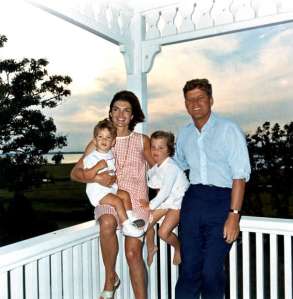
I admit, I have an interest in the Kennedy family— from their glamour to the tragedy of the President’s death. My grandmother loved Jackie’s fashion, and tries to convince me to dress like her. Naturally, I couldn’t resist writing a piece on the 50th anniversary of JFK’s assassination.
My main question was “Why is it fascinating?” and writing this article gave me some insight into my own interest.
It was also interesting to think about “Where were you?” moments in history and the impact they have on a person’s perception of the world.
Kennedy glamour, tragedy remembered 50 years later
Fifty years after the assassination of JFK, many people are still fascinated with the man and his death.
Art Blake, a professor of history at Ryerson University, said a large part of the fascination with Kennedy is that he was unlike other presidents before him.
“In some ways he was a more glamorous president,” said Blake. “He was a man of the twentieth century. He was young; he was handsome. And unlike other presidents, and most politicians up to that point, he dealt very well with the media.”
Presidential motorcade. Creative Commons
Kennedy and the media
The changing media played a large role in the public’s fascination with JFK long before he was shot, said Blake. Popular magazines such as Look frequently published pictures of the president and his family. When Kennedy was shot, the media was better equipped to cover the event, he said.
“It happened in a time when the capacity to cover major live events on television, radio, to inform the American people immediately of breaking news was much more possible than it had been before,” said Blake.
A major factor was television and the trustworthy presence of a newscaster like Walter Cronkite, he said. What made the difference was “the fact that he was the one from whom a lot of American people heard the news — and the fact that Cronkite himself was clearly shattered at the moment of hearing the news and having to report it live,” he said.
“That image of Cronkite and the footage that gets repeated of Kennedy and Jackie in the motorcade in Dallas, and seeing the president flip back in his seat and Jackie crawl to where his head is. From that vantage point, you can’t necessarily see what happened, but you can see it’s something bad.”
Fascinated 50 years later
With remembrance ceremonies taking place in Dallas, Texas and Washington D.C., the enthrallment with Kennedy and his death has not waned for many.
Patty Rhule is a curator with the Newseum in Washington D.C. and worked on a three-part JFK exhibit: Three Shots Were Fired is about the news coverage, Creating Camelot shows pictures of the Kennedy family’s personal life and One Thousand Days focuses on his presidency.
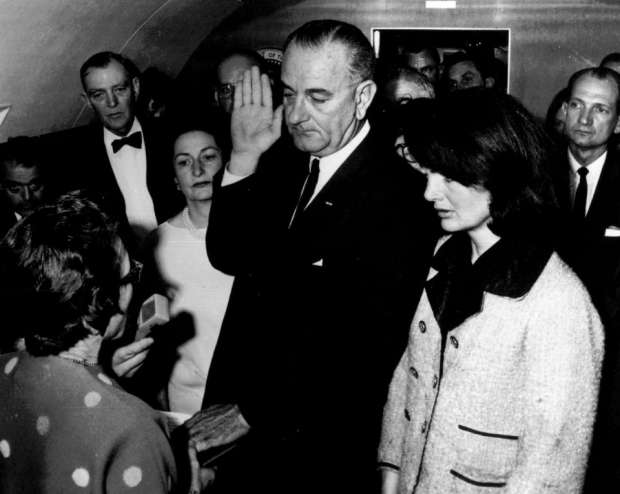
Lyndon B. Johnson sworn in beside Jackie Kennedy. Creative Commons
The exhibit, which opened in April, has been well-received, Rhule told Humber News.
“The response has been very powerful,” said Rhule. “People young and old seem to be transfixed by the media coverage of that day.”
The exhibit has many previously-unreleased artifacts from the U.S. National Archives connected with the shooting. They include artifacts such as shooter Lee Harvey Oswald’s wallet contents and the 8 mm movie camera used by Abraham Zapruder, the only eyewitness to capture the entire assassination on film.
Rhule said it was both chilling and humanizing to see the objects that played such a huge role in the event.
It also brought back her own memories of that day, she said.
JFK’s grave in Arlington Cemetery. Kateryna Barnes
“I was in first grade and I remember very distinctly my mother getting a phone call from a neighbour who told her the news,” Rhule told Humber News. “I remember seeing my mother, who was a pretty stoic lady, cry a little bit.”
As part of the exhibit, visitors are encouraged to write down where they were when they heard that Kennedy had been assassinated.
Since not all visitors were alive when he was killed, younger visitors are writing down their own ‘Where were you?’ moment — something Rhule said she finds intriguing.
“Young people are saying for some of them it was Sandy Hook; for some it was 9/11,” Rhule said. “It’s just really interesting to see what moments in time different generations perceive as the moment in time when life as they knew it was no longer the same.”
Remembrance Day has different meanings for many people– and it has a special significance for the Netherlands. Canada not only liberated the Netherlands from Nazi Germany, but the Dutch Royal Family lived in Canada during the World War II. I reached Anna Rijk, the Senior Officer of Public Diplomacy and Cultural Affairs at the Embassy in Ottawa and she spoke to me about what Remembrance Day means to the Dutch in Canada.
Rob Ford, Remembrance Day 2012, Old City Hall. Photo by Kateryna Barnes
There isn’t much commentary I can add to the Rob Ford saga– many Toronto-based columnists are owning this topic.
This saga is one that every newsroom is fascinated with and no one can’t look away.
In our newsroom, I was the one who saw the news break on Twitter. I was covering social media for my colleague who didn’t show up– this was the only reason why I was watching Twitter while @Humber was broadcasting. As soon as I shouted out “CBC NEWS HAS TWEETED THAT ROB FORD HAS ADMITTED TO SMOKING CRACK COCAINE!” our newsroom fell deadly quiet for a minute, then turned into sheer panic. Some quick rewriting of a Canadian Press wire and we threw it into our line-up for our host. Afterwards, we were ripping clips and running whole new segments in our show.
As a team, we killed it on our noon show on Tuesday. Judy Charles, our professor, informed us that we would have to do another show at 6 pm (when our show is normally a rerun). Five of us stayed until the bitter end: Charlotte Anketell (reporter/writer), Justin Vasko (writer/news reader), Hugh Smith (reporter/host), myself (reporter/studio director/producer) and Judy (professor/everything else).
We managed to get some great interviews, but one that took a lot of time on the phone, even if it meant I accidentally dialed a lot of fax numbers was a City Councillor: James Pasternak, Ward 10 York Centre.
I expect that everyone in news will be keeping a close eye on this story, as it keeps changing. Ford is like the cat that keeps coming back.
Growing up in a mildly sports-crazed family, it’s only natural that my heroes were athletes.
Basketball players in particular. My dad coached basketball and I grew up loving and playing the game. It also might have helped that our family’s hockey team was playing less than optimally during the 90s, so we turned to our team, the Chicago Bulls, for hope.
And were we ever lucky to have Scottie Pippen and Michael Jordan.
As I got a older, another player stood out to me. He was a point guard, like I was. He could sink a free throw with ease, drop a dime without seeing the shooter and he outfoxed just about any player on the court. I loved his play so much that I chose to wear his #13 for my varsity jersey.
Yeah, I love this unlikely star of professional basketball. It’s no wonder that I wanted to learn more about the new biography “Steve Nash: The Unlikely Ascent of a Superstar“, released today and penned by Toronto Star sports writer Dave Feschuk and Sportsnet reporter Michael Grange. I was able to have a quick chat with Feschuk for @Humber on the book and Steve Nash, and just in time for the start of the NBA regular season. Take a listen and find out why this book is next on my reading list.
It’s been a while since I’ve had so many numbers, dates, bits of info and more to confirm. The story that Kiah Welsh and I worked on for Humber News Online needed it– a timeline of events of the Senate expense scandal.
At this point, there is a lot of the story that is still missing. Probably only the RCMP and parties directly involved have all the details, but we tried our best to make sense of what happened and is still happening.
We made a few editorial decisions. We decided to focus on the current major players– the three Conservative senators: Mike Duffy, Pamela Wallin and Patrick Brazeau. While there are Liberal senators with questionable expenses, the stories don’t seem to be as tightly intertwined as these three. We also wanted lots of visuals– pictures, tweets, videos, reports and text galore.
Her first answer blew me away and I’m so glad that we were able to get the piece to air today, despite a tight line-up. (h/t to our @Humber crew and Prof Judy Charles who helped me get there and Lorna at NWAC for arranging the interview.)





 Kateryna Barnes